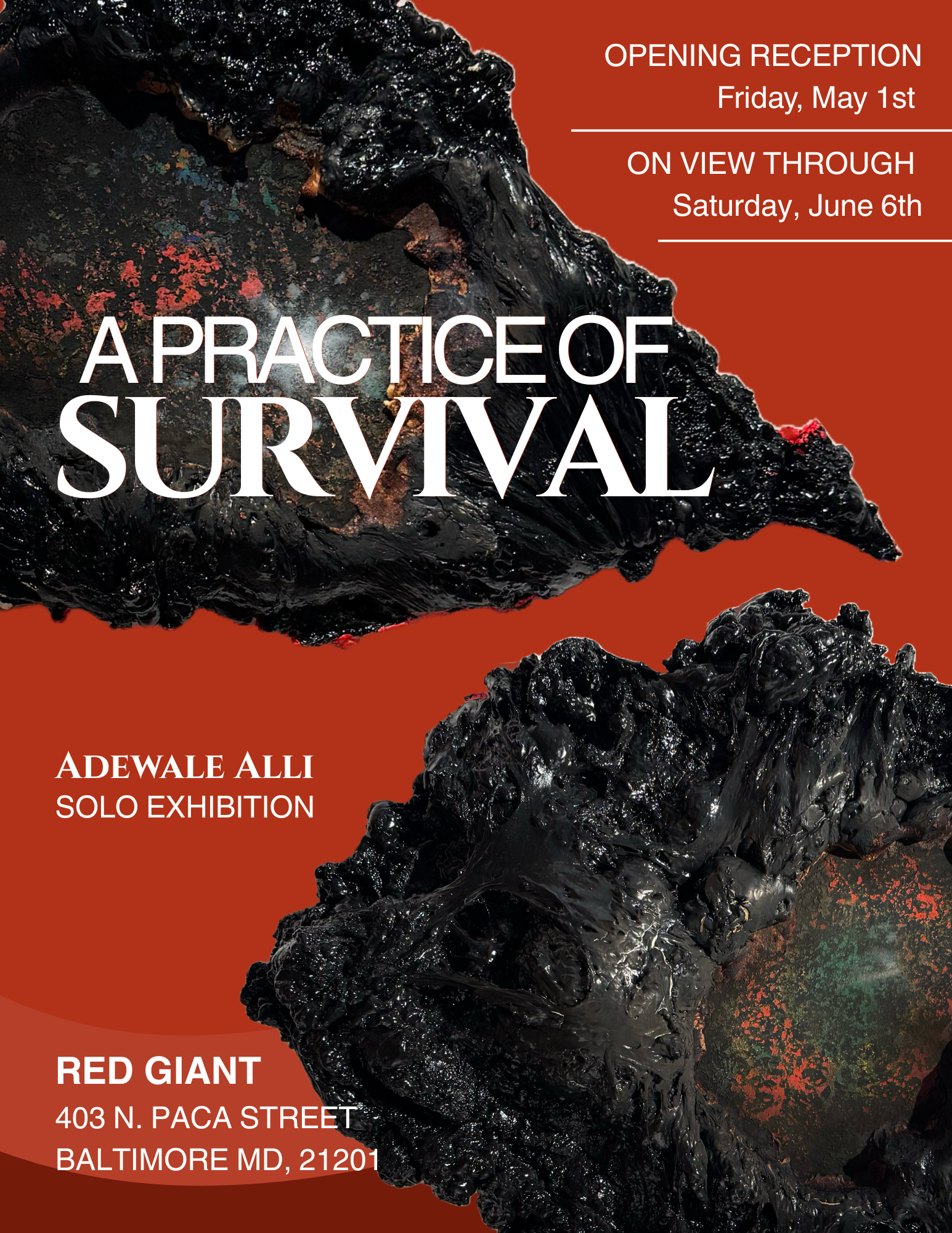
A Practice of Survival
Adewale ALLi
MAY 1 - June 6, 2026
In A Practice of Survival, Adewale Alli presents an intimate exhibition composed of four sculptural works from his Fragment series, accompanied by a central installation that both anchors and informs the development of the surrounding pieces. Pulling from the ongoing series, A Practice of Survival introduces what Alli describes as a study of “What Endures, Expands,” where material, pressure, and light converge to reflect both cosmic and human conditions.
The Fragment Series, referred to as C-Web Forms, draw from the structure of the cosmic web, the vast network of filaments that shapes the universe. Alli translates this phenomenon into physical form, constructing dynamic, irregular compositions that resist traditional framing. Rather than painting light directly, he builds surfaces through layered manipulation, allowing luminosity to emerge as a byproduct of the construction itself. In this way, the pieces echo the relationship between dark matter and visible light - where what is unseen structures what is perceived.
Alli’s practice is grounded in an understanding of the universe as a site of pressure, reaction, fusion, and tension. These same forces, he suggests, define human experience. “When I look into space,” Alli reflects, “I see processes that feel deeply human. Endurance, strain, release.
Conditions that produce new energy.” His practice mirrors this exchange, translating lived pressures into material form. Cracks, breaks, and ruptures within the fragments are not failures, but openings. Bearing spaces where light emerges and expansion becomes possible. Materially, foam serves as both foundation and language within Alli’s process. Its flexibility allows for cycles of compression and release, becoming a site where the artist can both experiment and return.
Over time, this engagement has developed into a rhythm that mirrors the training of a muscle, where repetition builds strength while remaining responsive to change. The fragments often emerge in moments of pause within Alli’s painting practice, functioning as a “zoomed-out” perspective. Where his portrait and cosmic series offer personal introspection, these forms construct the larger framework. The context of the world those internal reflections exist within.
Originally conceived to invite physical closeness, the works challenge the distance typically maintained between viewer and object. Their shifting forms and open structures resist containment, emphasizing instead a continuous state of becoming. In this way, the fragments operate as both interlude and infrastructure; what Alli describes as the “off story” within his practice. They are moments of recalibration, offering a universal vantage point from which to understand the cycles of tension and release that shape both the self and the world.
The works presented in A Practice of Survival consider how endurance functions as a generative force. In a world marked by constant pressure, where our daily exchanges often mask deeper strain - Alli’s fragments hold space for both weight and release. They suggest that within systems of tension, whether cosmic or human, expansion is not only possible, but inevitable.
Artist Bio
Adewale Alli (b. 1993, Nigeria) is a multidisciplinary artist whose practice spans painting, sculpture, and installation. His work draws from the cosmos as a language for endurance, transformation, and human divinity, using celestial imagery and sculptural form to create works that feel vital, immersive, and alive. Through stars, portals, and other cosmic phenomena, Alli explores the relationship between the body, spirit, and the larger forces that shape existence.
He has exhibited across the United States and internationally, with recent exhibitions including Residual Frequency at Flying House Arts Collective (Baltimore, MD), Stars & Portals at Creative Alliance (Baltimore, MD), and Soul(I): Mostra de Arte Afro-Diaspórica at Artspace Vigidal (Rio de Janeiro, Brazil). His work has also been presented at institutions such as the Fred Lazarus Center at MICA, the Chesapeake Arts Center, and the University of Maryland School of Medicine. He is currently based in Baltimore City at NEOM Studios, an experimental space where art and technology converge through sensory-led exploration.